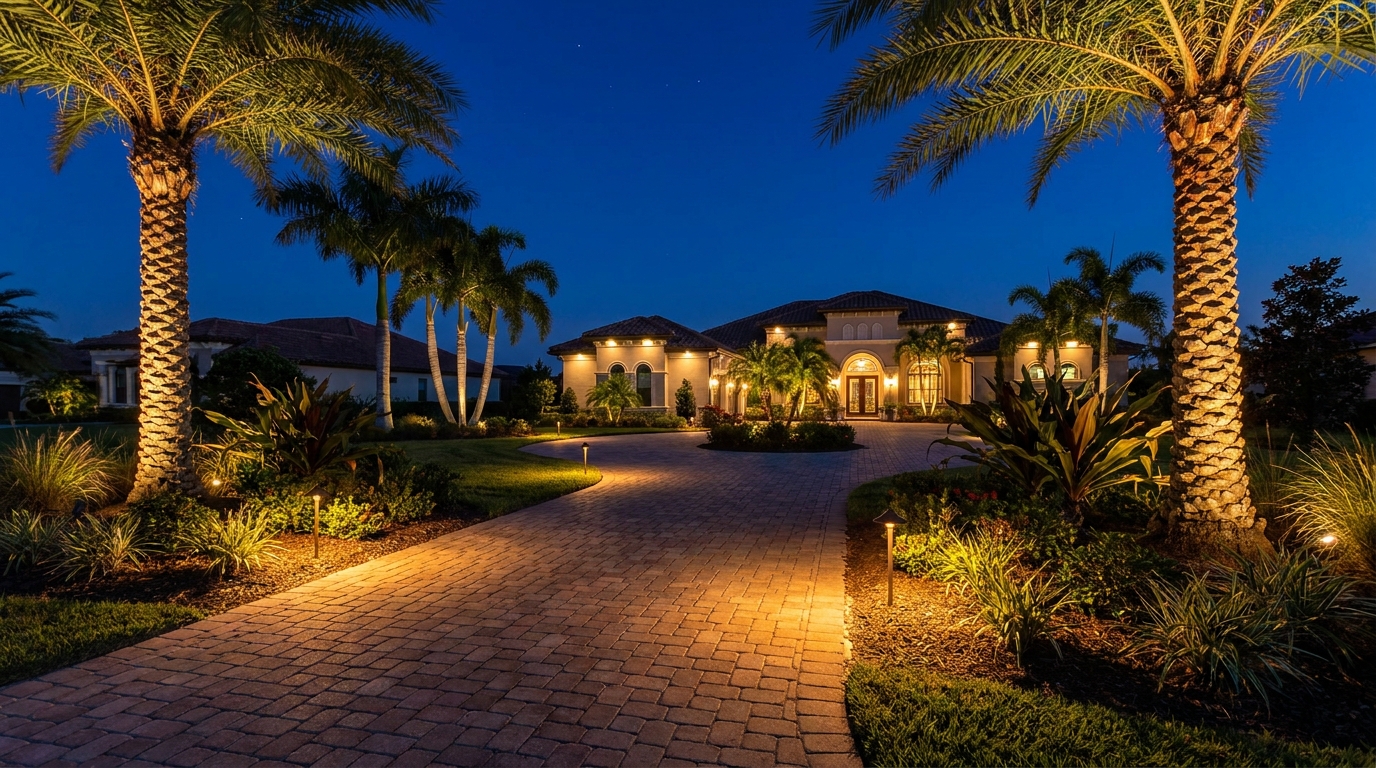
Landscape Lighting 101: Make the Yard You Paid For Visible After 7 PM
You own the yard 24 hours a day but can only see it for 12. Path lights, uplights, and the low-voltage basics that transform a Florida home at dusk.
Here's a thought that annoys people once they have it: you paid for the landscaping, the lawn, the palms, the beds — and for half of every day, none of it exists. The sun goes down and your property line might as well be a wall.
Landscape lighting is how the yard earns its keep after dinner. Done right, it's also the single biggest "wow" moment guests get pulling into your driveway.
The three moves that matter
- Path lights — low, warm pools of light along walks and drives. Guidance first, glamour second. Fewer, better fixtures beat a runway of cheap ones.
- Uplights — the transformer. A single warm uplight washing a palm trunk or an oak canopy turns a tree into architecture. This is 80% of the drama.
- Wash lights — soft, low light across a facade or a garden wall, tying the scene together instead of leaving islands of brightness in the dark.
Why low-voltage changed everything
Modern systems run on 12 volts with LED fixtures — safe to install around irrigation, cheap to run all night, and bulbs that last years instead of months. Warm color temperature (around 2700–3000K) is the rule; cold blue-white light makes a landscape look like a parking lot.
Where people go wrong
Too many fixtures, aimed at nothing in particular. Lighting design is choosing what not to light — darkness between the highlights is what gives the scene depth. Start with the two or three best features your yard has, light those well, and stop.
We design and install lighting as part of our hardscape work — it's the finishing move on almost every backyard project we do.
Want it handled instead?
Every Golden Grass visit runs the 9-Point Golden Cut — cut, edges, beds, irrigation eye-check and all — with photo proof to your phone. If it's not right, we re-do it free within 48 hours.
Claim My First Golden Cut